Saturday
Jul092011

"My hands would smell like meat all day."

It’s funny what you take home from trips. When I was younger I would hunt for license plates wherever I went, eagerly trying to complete my collection of brightly colored, numbered-metal covering my bedroom walls like rusty bricks. Then I moved on to rocks and shells, putting them in neat little glass dishes and bowls. And after running out of horizontal space to put these miniature beaches and deserts I moved on yet again.

Shot glasses and fridge magnets have never appealed to me. Something that everyone else could have gotten from a far away locale just doesn’t seem like a worthwhile travel memento. My trips are unique to me, unlike any other traveller’s experience even in that same place. From Vegas to Venice, and now most of all in Ghana, I’ve been collection my new souvenirs, stories and photos. The calzone stolen on the Grand Canal by a seagull, the snowfall in Central Park, the dewy morning on that rocky beach in Mexico; all of these pale in comparison to any one experience I have had on these few trips to Ghana. This place has taught me to cherish what I have, made me realize how fortunate I am, and has perpetually renewed a commitment to help those less fortunate.


 Everyday I am fortunate to meet people that inspire me. Isaac is a man of firm faith and a great father, extremely honest and happy, even when he’s got the stomach flu! Kweku is someone who could have used his talents and practical knowledge for a comfortable life abroad, but instead stayed in Ghana where he is most needed. The mother of 4 who, in any other country, could be a member of parliament or a CEO, but instead smokes fishes to make provide for her family. But of all the wonderful people I’ve met in Ghana none has left more of an indelible mark on me than my friend Muftawu Muhammed Abubakari.

Like any first time traveller to Ghana, the initial few days are overwhelming. Sights, sounds and smells come at you with fire hose intensity, leaving even the fastest mind ill equipped to process it all. After long days out exploring I would often come back to the little apartment I stayed at and spend a few hours talking with my new friend Muftawu. We would ask each other questions about our very different lives and the responses I got have done much to shape who I am and who I’m trying to become.

What’s your favorite food?

            I eat whatever I can afford.


Do you like to swim?


Yes, I went to the beach once with 3 friends,


2 of them weren’t strong swimmers and they died.


What do you do when you get bored?


            Bored? What is bored?


 But perhaps the most impactful story I’ve heard has been about his childhood and the great lengths he has had to go to for an education. At a young age his mother passed away. His father felt he would be better cared for by extended family who lived 7 hours to the north, a great distance to the average Ghanaian. Muftawu says that he liked living with his cousins and having new friends but his uncle was mean and didn’t allow him to go to school. After 12 years of living away from his father, and only 2 years of school under his belt, he ran away. By gathering scrap metals with a friend he was able to buy a bus ticket that would take him back to Accra where his father lived. Although he hadn’t been to his house in over a decade, or even seen his father for that matter, he found where his father lived and was welcomed back home. He finished Ghana’s equivalent of middle school but then didn’t have any money for High School. A friend acquainted with Lybia promised him steady work and a safe place to live if he could only get there.


 After a dangerous trip on a hired bus he made it through the desert into Lybia where the streets weren’t exactly paved with gold as his friend had suggested. No work, no food, one room for far too many people, and no visa would be his life for the next 3 years until he had earned up just enough money for school. He returned home and started buying the books he would need for his classes. Nearly all his money went towards school supplies, until he saw a young boy who he thought needed them more than him. So he gave them away and started again.

There are so many details and intricacies in his life’s story that I am just incapable of writing about. But the skeleton of a story presented above makes me question how someone can go through so much for something most people see as a hassle? It’s funny to me how much of a curse school is to most of those fortunate to have it and how sacred it is to those without it. Muftawu says of his childhood, “Sometimes it makes me happy, sometimes it makes me cry.”

Not everything we talk about is morbid or macabre; most of it is happy and enlightening. We talk of our beliefs, our families, school, work, and stories from distant memories or about the future. Last week we were talking about Halloween. I described it as a night when kids get dressed up in costumes and go from door to door collecting candy. Muftawu said, “Oh, that’s just like a festival we have up north where people walk around with torches and beat each other and fire guns.” Ok, where’s the candy come in? After devouring an entire pizza one Saturday afternoon I began expounding on the different types of pizzas, who makes the best, the difference between thin crust and hand tossed and deep dish and all the toppings. We got to olives and I remembered a cherished childhood memory:

            “When I was younger I used to put the black olives on my fingers and pretend I       was a monster. I’d run around roaring like a lion and then I’d eat them off my fingers until I was sick.” To which Muftawu replied, “Me too, except with goat intestine. My hands would smell like meat all day.”


 Who else gets to bring home that experience? I guarantee they don’t make a shot glass or magnet with this kind of stuff on it!
Friday
Jul012011

“Where’s your duct tape?”

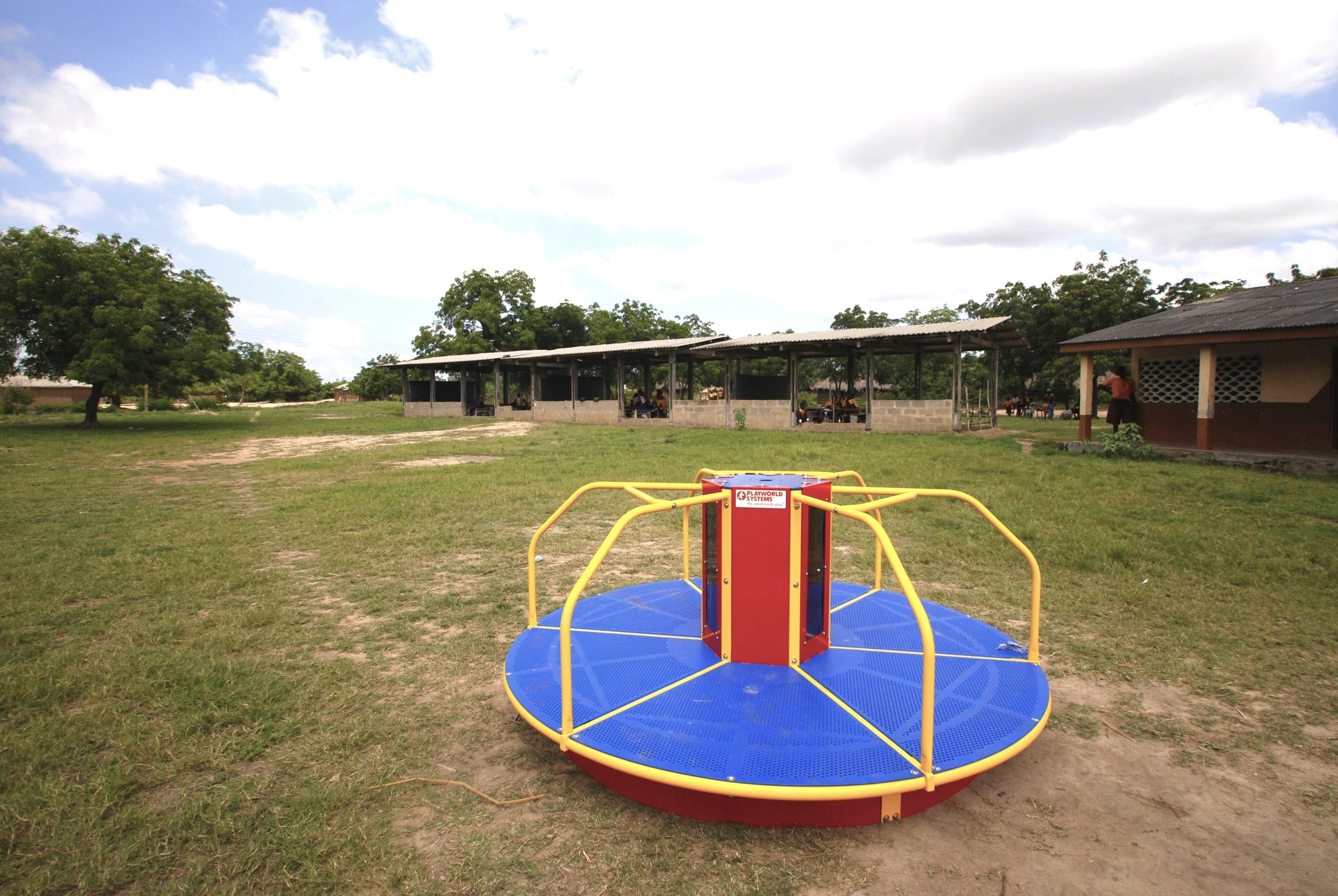
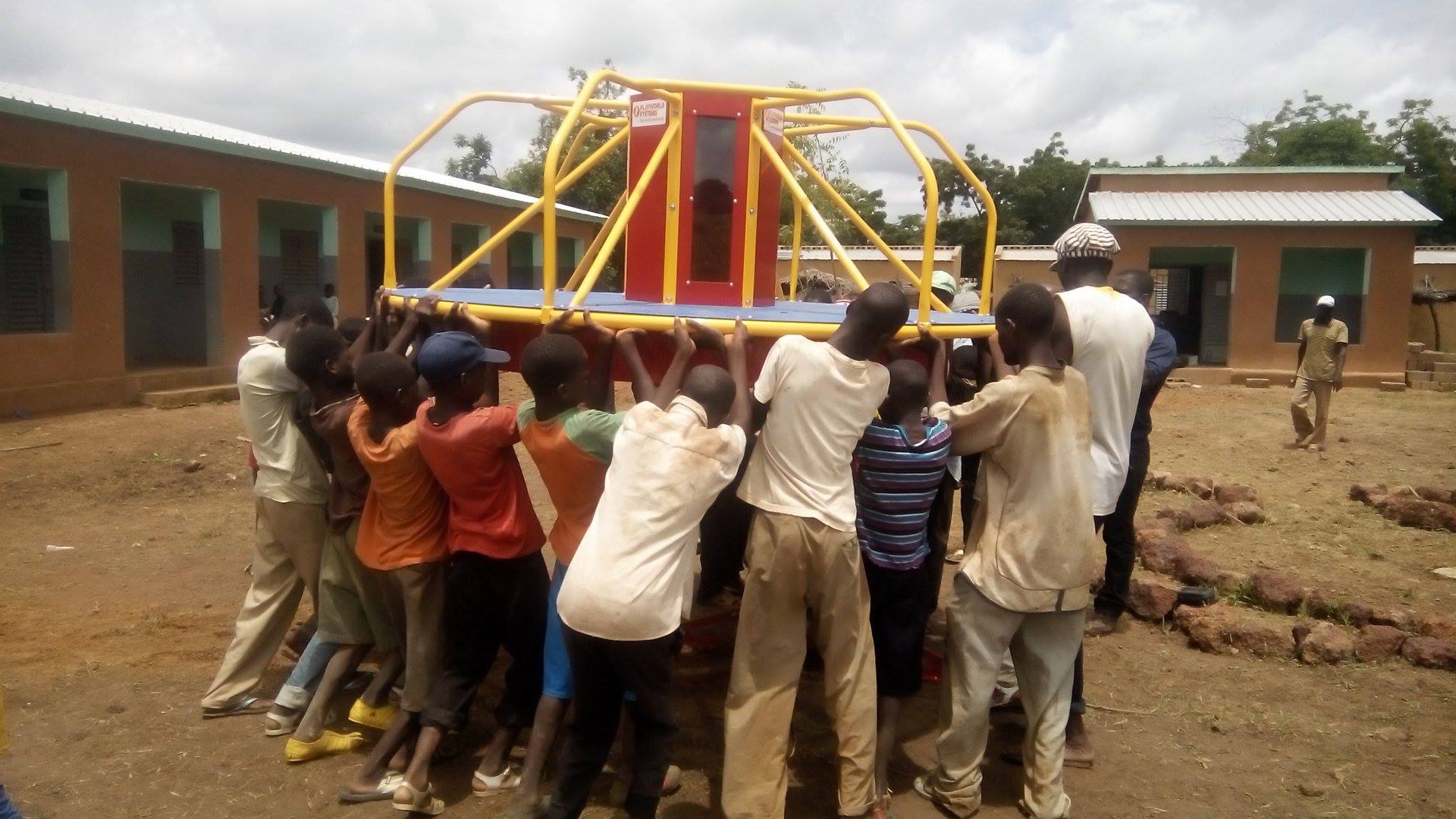
Who knew such an innocuous question could have so much importance? It all began Wednesday night when I was packing for a visit to the Volta Region the following morning Kweku knocked on my door and asked for Duct Tape. (For background, Kweku has been instrumental in the development of the electricity-generating merry-go-round and EPI shares an office space with his engineering shop.) I searched the office but to no avail. “Doesn’t every American have duct tape?” he asked. I replied that I had a roll in my car, one in my desk, and an extra one in a kitchen drawer at home but none had forgotten to bring any with me when it hit me; I’m now African American. I eat the food, watch Nigerian movies, I'm trying to speak the language, I have local beads and fabric and everything. This revelation was fulfilled today while out running errands with Isaac. We were intellectually discussing the difference between Europeans and Americans while playing one of my favorite games “Name that Obruni” when he included me in a statement about Ghanaians. I fail to recall what exactly the statement was but the “us” that had formerly excluded me is stuck in my mind. To prove my new nationality I celebrated by purchasing an elephant. That’s right, an African Elephant.

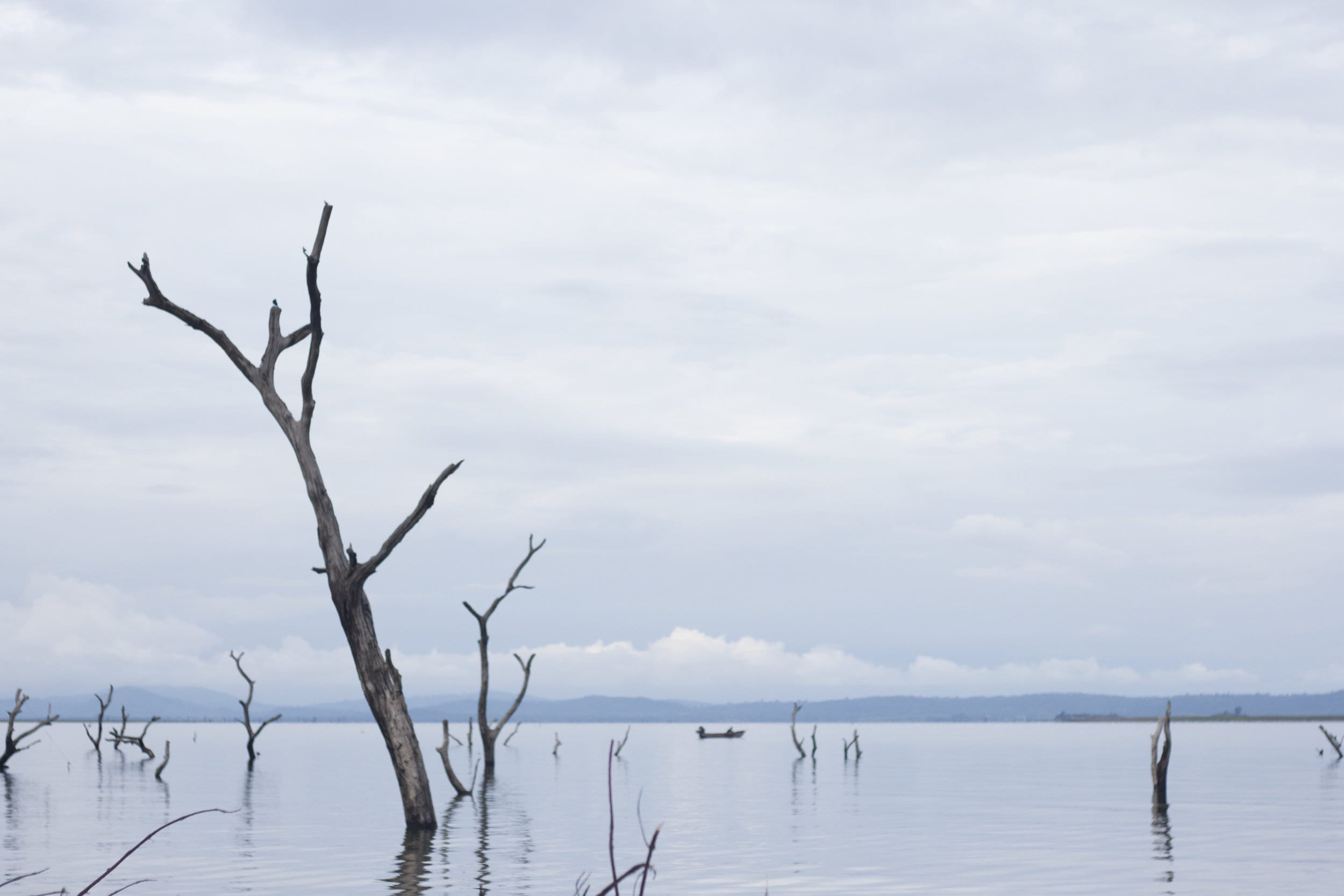
But don’t rush to alert customs or anything. This elephant is only 18 inches high and made of “ebony” wood, meaning some tree with shoe polish on it, but I love him all the same. His name is Kofi, the Ghanaian name for a boy born on Friday, and he will fit in nicely with my new flour sac pillows and burlap bag ottoman. But the duct tape omen goes even deeper than my new furniture acquisition. Yesterday it could have signaled the end of my life, or at least a long swim. (Boti Falls)Close your eyes for a moment…are they closed? Imagine Africa; recall all you’ve learned from school and Hollywood about this behemoth of a continent. Now open them. You’re wrong. As I’ve already mentioned, Ghana is nothing like my mind’s picture of it; and the trip to the Volta Lake only confirmed this new revelation. So what does this have to do with duct tape? Water, that’s what. More specifically, keeping water out of my canoe! A canoe that was in the middle of a very large lake, in 2 foot rolling waves and leaks springing up everywhere.

We’ve made it a goal recently to explore the islands that are seemingly everywhere in Ghana in search of potential schools. We’ve had great luck in the Lower River Volta with Pediatorkope, Alorkplem, Aflive and Tuanikope Islands and have already planned an installation at Kpala (Paula) Island in the Volta Lake. These island schools and villages are isolated and often very deprived, and after yesterday’s boat trip I better understand why. Getting to the islands in the lake is difficult, often taking upwards of an hour once you’ve secured a boat. On our last trip we went with a large boat that carries locals back and forth on market days with their goods and, much like the buses and taxis on the mainland, doesn’t leave until every square inch is full of something or somebody. A smaller boat reserved just for us would get us there faster and make visits to the island easier, but we didn’t take into account bad weather and the bumpy ride it would make for our little crew.

After replaying Titanic over and over in my mind, “Never let go Jack, Never let go,” we made it to our destination. The clouds parted, the sun shone through, and we found two gems. These little islands have deplorable facilities, lack supplies, and struggle to get teachers stationed at the remote little villages. There are fleeting moments when everything seems to melt away; all your problems, deadlines, traffic and noise disappear and you focus on what’s in front of you. This island trip was one of those moments. Everything leading up to it was worth it. And anything it takes to get some help to the children I met there will be worth it as well.

Saturday
Jun252011

“But why?”

 I like the old adage “Beauty’s in the eye of the beholder.” There is something magical about taking the everyday and making it seem special. It holds true for photography, architecture, art and even some marriages I’ve seen, but what about an ottoman and pillows?

I’ll be the first to admit, with my mom a close second, that I’ve always been interested in interior design and stuff like that. I vividly remember clipping pictures out of old Better Homes and Gardens issues and putting them in my “Dream Home” folder when I was younger, a practice now digitized to a folder on my laptop titled with the same name. And now that I have my own place (sort of) I’ve gone crazy gathering things that I think show my personality, tell the stories of my travels, and hopefully make others feel at home in my second floor apartment. Why am I talking about this? I’m half way across the world, separated from my nest by an ocean and 2 half-continents. Because I’ve found something awesome, flour sacs and cocoa bags! Yep, that’s right, flour sacs and cocoa bags. Stay with me here.

I fell in love with the crisp white, tight-knit fabric flour sacs the first time I came to Ghana and have been on the hunt for them ever since. They seem to be used for nearly everything around Ghana; baby wraps, smock linings, bread stand covers, awnings, and even sailboat sails. For some reason I feel drawn towards the blue and red of the Tema hard spring wheat flour and the warm orange of the Takoradi flour mill bags. And similar to that girlfriend I had in second grade, I knew I wanted one but didn’t know what do to with it when I finally got it. But now I do, pillows. I’m going to make pillow for my brown leather couch, and after a quick Google search I’ve filled my mind with interesting ideas. And the cocoa bag, what will its future be? Well an ottoman of course! I dream about an old reclaimed ottoman re-skinned in a Produce of Ghana, 100% Cocoa rich-smelling burlap.

And where did I find the materials for my Sistine chapel-esque masterpiece? Well the dirtiest and most hectic place ever of course, the Kejetia market in Kumasi. It’s been a while since I was actually there but it’s taken this long to recover from the chaos, smells, and traffic that rule the largest market in West Africa. I’ve heard it said that driving through Ghana is like going down the aisles of Wal-mart, which is as apt an explanation as I’ve ever heard. But going through Kejetia market is like clawing your way out of the bowels of hell through hoards of sweaty, hurried people, heads and arms pilled high with everything imaginable. A once in a lifetime experience for a reason, I never want to do it again. The responses I’ve gotten from people regarding my flour sac and cocoa bag upholstering projects have maybe been the best part of the whole deal. My favorite was simply put“but why?” I guess the beauty of reclaimed fabrics is lost on some, but it resonates well with me.
Sunday
Jun192011

“There’s more to be seen then can ever be seen”

I had one of those eye-opening experiences this week, an epiphany if you will. It was early morning about 5am. Isaac and I were driving down the road on our way to Tarkwa and a school neither one of us had been to before. We were listening to music, windows rolled down and the cool wet morning air whipping through my newly sun-bleached and cut hair (I’ll get to that) generally having a great time. And then it hit me, right there in the middle of the morning congestion and women hawking warm rolls, I’m in Africa listening to The Circle of Life.

 As I’ve said many times before, there is no way to describe Ghana, no all encompassing phrase or specially crafted word that transfers an experience like this from my senses to yours; you just have to experience it. But to have the Disney designed Africa of my childhood run haphazardly into the Africa I have experienced in great detail was… well, trippy for lack of a better word. There were no lions hoisting cubs over sun tipped cliffs, no menacing hyenas plotting my demise, not even an omnipotent blue-butted baboon to explain life’s meaning, just me and Isaac in an Indian made car cruising down the road listening to a childhood fantasy reliving itself. To stereotype an entire continent with one movie, especially one with talking animals, is ill advised at best and downright dangerous at worst. The big realization was that I’m doing one of the things I have dreamed of from boyhood, and although it’s different than I had imagined it, it’s nonetheless a dream come true (And yes, there have been a few monkeys along the way).


 There have been other revealing experiences this week as well, one of which was a little more important than my pre-dawn Disney moment. As some of you may know, I’ve had a cold for a few days, nothing major but still a hassle to say the least. No one likes to be sick but I must admit I tend to get a little whiny when I feel under the weather. But this time I forced myself to be more Ghanaian and I think it helped a lot in my recovery time. So what does it mean to be more Ghanaian? It means to find the silver lining in all things, no matter how bad. It means to be happy even when life’s circumstances tell you to do otherwise. One boy I met this week personified this way of life. His name is Andrew.

Andrew is a student at a school near the Volta River in a little village named Obane. We were passing through on a mission to repair a piece of their merry-go-round when, as always, a crowd of kids came out of nowhere and watched us inquisitively. I noticed one of the boys had a small hole in his neck surrounded by scar tissue. I asked him what happened to his neck and he just smiled and disappeared into the crowd of boys. Undeterred, I got Isaac to ask him what happened but they spoke different dialects and didn’t understand each other. Worried, I went for my trusty camera and snapped a few pictures to bring back to Accra and to show one of our doctor friends. The whole way back to Accra I kept thinking “how does this boy have a normal life?” He seemed happy, even healthy, and when I asked one of his teachers about the hole he said he had never noticed it before. If I had a hole in my neck everyone would know about it! If I stub my toe on Monday it comes up in conversation Saturday right after the salutations. But Andrew just goes right along with his life despite his problem. And what’s even more revealing is that those around him don’t define him by his problem because he doesn’t either. You will all be pleased to know that Andrew's hole is not life threatening, but we will be getting him into a doctor just to make sure.

And that brings us full circle back to my haircut. I've tried, there is no silver lining there.

No positive side.

No redemption.

It's bad. Biblically bad.
Friday
Jun102011

“Let’s shame him. 1-2-3 SHAME!”

Have you ever had that dream where you’re standing in front of a large class of peers trying to answer some ridiculous math equation when you realize you’re completely naked? Really, no one besides me? Be honest. I guess I have sort of a math-phobia, an algebra-induced illness you could say, that has plagued me for years. It all started in 6th grade when my family moved back to California from the backwoods of Missouri. The new school I was at was leaps and bounds ahead of Triway Elementary where I was previously an average student. I felt as if they were speaking the most elaborate french most of the time and I was still scratching stick figures into the dirt clad in a buckskin loincloth. And then there were the math homework sheets, a sheet of paper almost as long as I was tall, each row of questions having a “check up” question at the end of it to make sure your answers were all correct. Invariably one or more of my answers from each and every row were wrong, which meant my check up question at the end was also wrong, sending me into a relapse of hysteria trying to find out which question was to blame for my lost after school play time. Then the first symptom of my illness reared its menacing head. I began to get “coughs” the morning before a big test keeping me from school and keeping me from showing just how little of this new language I understood. Over the years the disorder has gone into remission, only flaring up the fall of 2008 during Stats 121, but it has left an indelible mark on my psyche. And an unusual event this week in Bolgatanga brought the haunting dreams back to me.

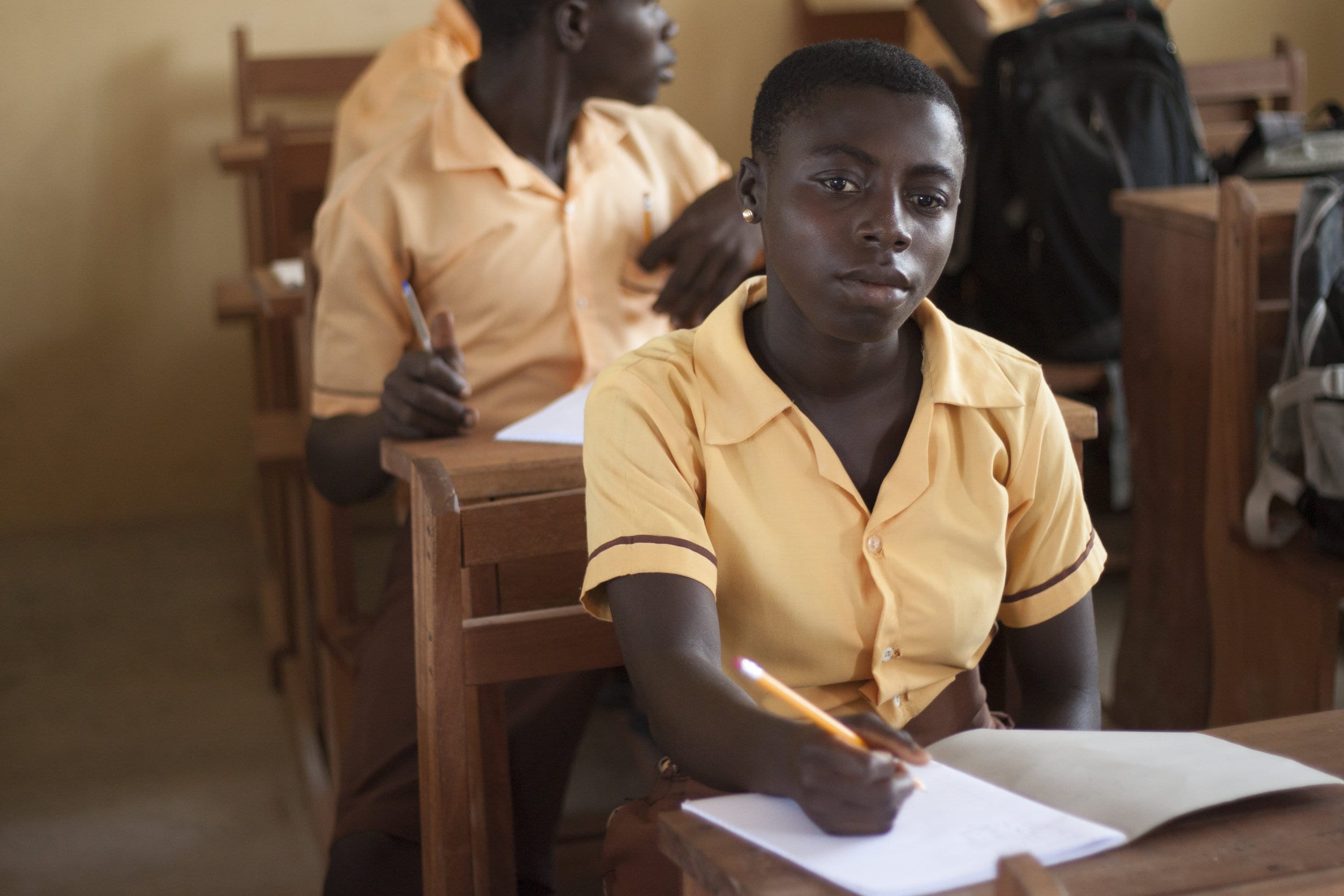
Isaac and I were way up north in the upper-eastern region of Ghana selecting some schools for EPI’s electricity-generating merry-go-rounds. Each school was different, some in large block buildings, others in mud shanty rooms, and one had four classrooms outside under large shade trees. At first I was dumbstruck by the sheer number of students who learned without any sort of accommodations, no desks, no books, just a chalkboard leaning against a tree and a mat on the floor for them to sit on.

One of the teachers, a young woman probably mid-twenties, was teaching them English. She had written phrases on the board and was reading them aloud as the kids parroted them back to her, never actually looking at what was written. Soon it was their turn to go to the board and read a phrase while pointing at each word with a stick, Ghana’s version of follow the bouncing ball. One boy was in front of the class “reading” the phrase “may I go out please?” which is very American, in Ghana the please always comes first, “please, may I go outside?” After several attempts and an equal number of failures the teacher said to the class “lets shame him, 1-2-3 SHAME!” all of the students pointed at the unlucky boy and shouted “SHAME, SHAME, SHAME!” and I was horrified. This was my worst fear as a student, and perhaps still is, lodged somewhere in the recesses of my squishy mind right behind the names of capitals and the difference between a noun and pronoun. As soon as we got back in the Tata I consulted with Isaac “is that normal?” He assured me that this wasn’t the standard form of teaching and that the woman was untrained, somewhat soothing to my sudden onset of nausea. Luckily this school will be one of the many getting one of EPI’s merry-go-rounds soon.

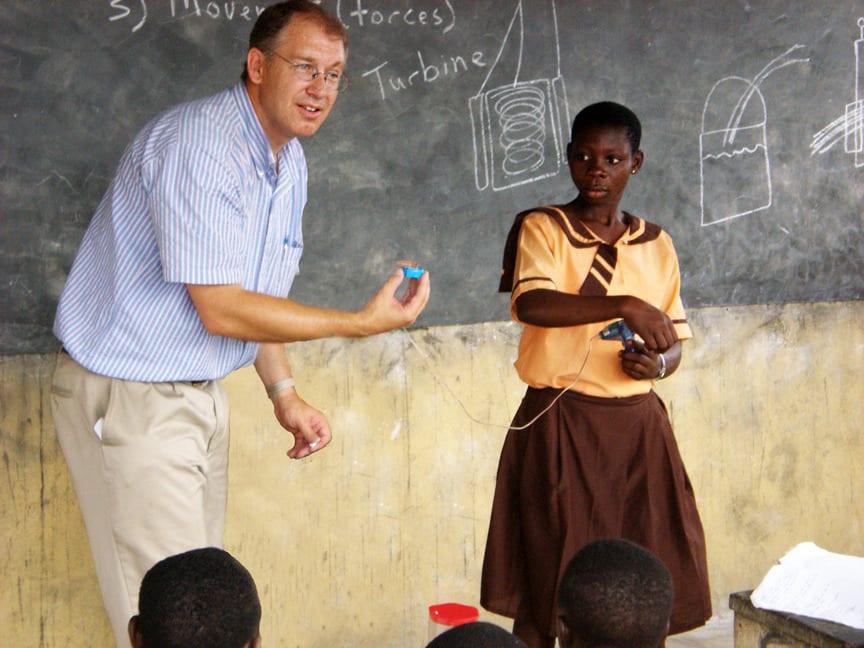
Besides just a toy that produces light, an EPI system provides the teachers with some training on more effective teaching styles. With each merry-go-round or swing we install we provide hands-on science kits that the teachers use to supplement the government provided curriculum which is rich in memorization but lacking in actual experience with concepts. The goal is larger than just cementing scientific tidbits into student’s brains; hopefully the teachers will learn how to teach all their subjects more effectively, enhancing each and every discipline taught in a classroom or under a shade tree. Then students will fall in love with learning and the terror that I had as a child will disappear.